
|
EN
Subscribe to our Newsletter
Luxury is rarely static, and in Louis Vuitton’s Spring–Summer 2026 menswear campaign, motion becomes meaning. Under the creative direction of Pharrell Williams, the House revisits its historic connection to travel, not as nostalgia, but as evolution. This season, movement is not simply about geography; it is about identity in flux, about the refinement that comes from crossing cultures and inhabiting the space between departure and arrival. SS26 does not merely present clothes, it presents a philosophy of modern elegance shaped by transit, transformation, and global perspective.
By the Editorial Staff
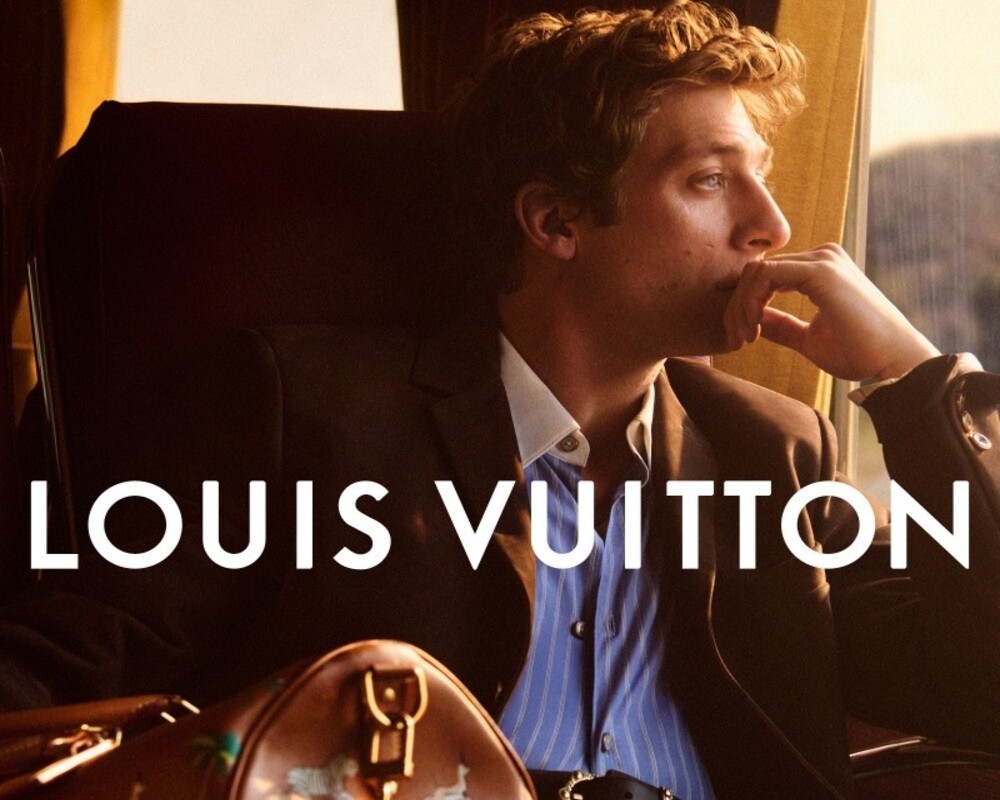
Photo: Louis Vuitton, Drew Vickers
Luxury has always thrived on storytelling, but Louis Vuitton’s Spring–Summer 2026 menswear campaign transforms narrative into experience. Rather than simply presenting clothing, the House explores the emotional and cultural weight of travel , not as a destination, but as a continuous state of becoming. Under the creative direction of Pharrell Williams, Louis Vuitton once again redefines its historic relationship with movement, heritage, and modern masculinity.
For a brand whose DNA is inseparable from the art of travel, this campaign feels less like a seasonal presentation and more like a philosophical continuation of the Maison’s legacy. Louis Vuitton does not merely celebrate movement; it suggests that identity itself is shaped through transition, through the spaces between departure and arrival, familiarity and discovery.
Since its founding in 1854, Louis Vuitton has existed at the intersection of craftsmanship and exploration. Originally created to serve the needs of travelers, the brand has consistently evolved travel into a broader cultural metaphor. In Spring–Summer 2026, this legacy finds renewed relevance through Pharrell Williams’s creative vision.
The campaign captures travel not as spectacle, but as introspection. The imagery reflects moments suspended in transit, the stillness inside motion, the quiet intimacy of personal journeys. Clothing becomes a companion to movement, adapting fluidly to shifting environments and identities.
The garments echo this philosophy through relaxed tailoring, tactile fabrics, and silhouettes designed for mobility. Rather than rigid formalwear or purely casual attire, the collection exists in a nuanced middle ground, reflecting the wardrobe of a global citizen constantly navigating new landscapes.
Since assuming his role as Louis Vuitton’s Men’s Creative Director, Pharrell Williams has brought a multidisciplinary perspective that merges music, culture, and fashion into a unified creative language. For Spring–Summer 2026, Williams builds upon his fascination with cross-cultural dialogue, drawing particular inspiration from his journeys between Paris and Mumbai.
These influences are not translated through literal references but through mood, palette, and material exploration. Warm sun-faded tones dominate the collection, creating a sense of garments shaped by travel and time. The colors feel organic, suggesting clothes that belong to lived experiences rather than staged luxury.
Williams continues to redefine contemporary dandyism, shifting it away from rigid aristocratic codes toward a more expressive and democratic elegance. His interpretation embraces individuality, suggesting that refinement today is defined not by rules, but by personal narrative.
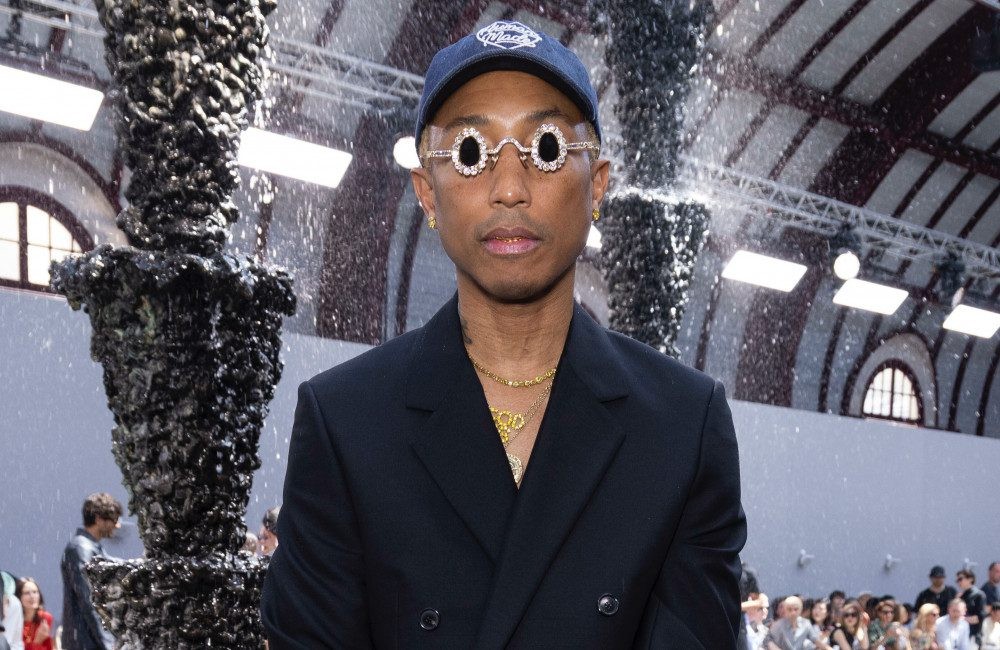
Louis Vuitton’s Men’s Creative Director, Pharrell Williams
Photo: Getty Images
The casting of Jeremy Allen White and Pusha T reinforces the campaign’s thematic depth. Their contrasting personas embody two distinct yet complementary interpretations of modern masculinity.
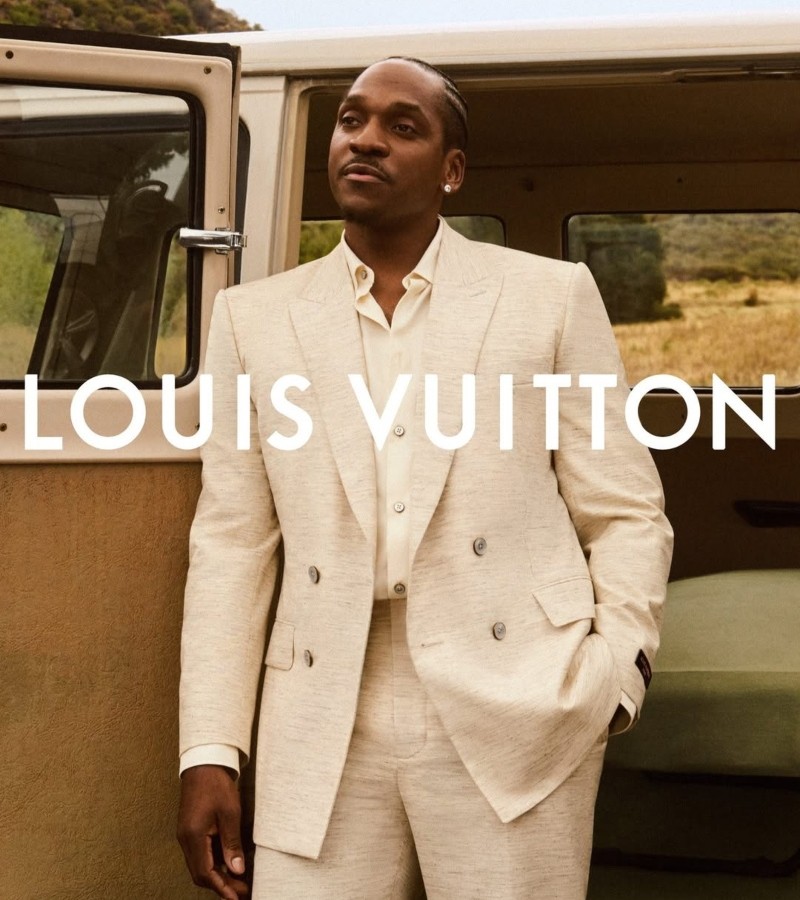
Pusha T represents structured sophistication. His looks emphasize precision tailoring softened by fluid movement. Wide lapels, jacquard textures, and embroidered denim reinterpret traditional formalwear through a contemporary lens. His wardrobe evokes the elegance of historical tailoring while maintaining a sense of effortless modern confidence.
Jeremy Allen White, by contrast, introduces a rawer, more instinctive energy. His styling emphasizes tonal layering and material contrast, blending coffee-toned denim with washed pastel shades. The result feels spontaneous yet intentional, capturing the unpredictable nature of personal style shaped by travel and cultural exposure.
Together, they create a visual dialogue between discipline and freedom, heritage and experimentation, stability and transformation.
Beyond aesthetic storytelling, the campaign reaffirms Louis Vuitton’s mastery of material innovation and craftsmanship. Fabrics emphasize durability while maintaining lightness, reflecting the practical demands of travel without compromising luxury.
Jacquard textiles introduce intricate patterning that blurs the boundary between structure and ornament. Embroidered denim elevates casual wear into collectible artistry. Fluid tailoring ensures garments move naturally with the body, reinforcing the collection’s central narrative of transition.
Accessories remain fundamental to the Maison’s identity. Travel icons such as trunks, Keepalls, Speedy bags, and totes appear reinterpreted through modern materials and subtle design evolution. Each piece reflects the marks of imagined journeys, reinforcing Louis Vuitton’s heritage as a creator of objects designed to accompany life’s movement.
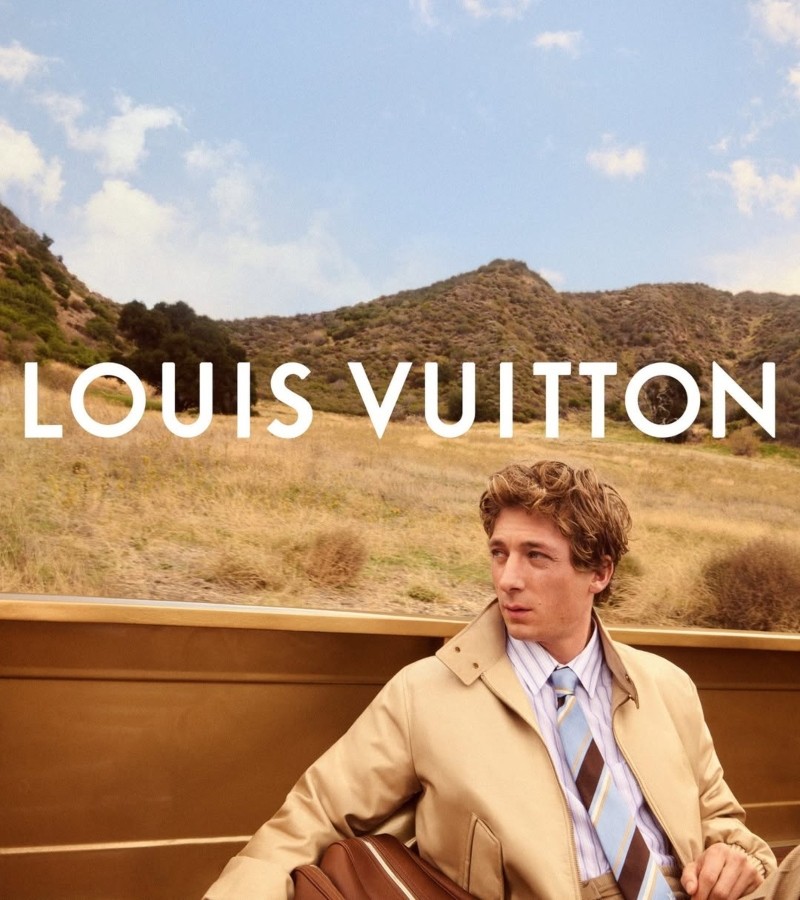
A distinctive dandyism emerges, rooted in cultural exchange and contemporary refinement
Photo: Louis Vuitton, Drew Vickers
Pusha T embodies a renewed vision of the travel wardrobe. His looks combine precision with freedom, echoing historical elegance while embracing modern comfort
Photo: Louis Vuitton, Drew Vickers
Photographed by Drew Vickers, the campaign’s imagery avoids traditional fashion staging in favor of atmospheric storytelling. Scenes unfold across railways, open highways, and transitional landscapes, spaces that exist between destinations rather than within them.
The camera frequently adopts perspectives that mimic personal travel experiences: views through train windows, glimpses from moving vehicles, solitary figures against expansive horizons. These visual choices emphasize introspection and quiet emotional resonance rather than overt spectacle.
The campaign ultimately suggests that travel is not defined by geography but by transformation. Style becomes a visual record of experience, capturing how identity evolves through exposure to new cultures, environments, and perspectives.
Spring–Summer 2026 marks another step in Louis Vuitton’s ongoing evolution under Pharrell Williams. The collection reflects a growing shift within luxury fashion toward fluid masculinity, cultural hybridity, and emotionally driven design narratives.
By merging heritage craftsmanship with contemporary global influences, Louis Vuitton reinforces its position as both a guardian of tradition and a catalyst for modern creative expression. The campaign presents fashion not simply as clothing, but as a language of movement, memory, and individuality.
Ultimately, Louis Vuitton’s Spring–Summer 2026 menswear campaign proposes a vision of luxury rooted in experience. It suggests that style is no longer defined by fixed destinations or rigid identities, but by the journeys that shape who we become.
This article is an original editorial analysis produced by [DIBA magazine]
Research and references are used for contextual accuracy.