
|
EN
Subscribe to our Newsletter
A poetic requiem for Iranian classical music, Delshodegan stands as one of Ali Hatami's most personal and elegiac films, where sound, loss, and cultural memory converge in quiet defiance against oblivion.
By the Editorial Staff
Released in 1991, Delshodegan is among the most intimate and deeply personal works of Ali Hatami, less a conventional historical drama than a ceremonial farewell to an era, a language, and a way of life. Hatami’s presence permeates every layer of the film: he serves not only as director, but also as screenwriter, producer, financier, and production designer. The result is a work that feels less like a film and more like a cultural testament, an elegy carefully composed for a vanishing world.
Drawing freely from three real historical journeys undertaken during the Qajar period, Delshodegan revisits the early expeditions of Iranian musicians who traveled to Europe to record some of the first phonograph records of Persian music. Yet Hatami does not approach history as documentation. Instead, he reshapes it as memory, fragmented, emotional, and haunted. What unfolds on screen is not a factual reconstruction, but a meditation on the Iranian artist’s fragile position at the threshold between tradition and modernity, preservation and erasure.
A group of classical musicians, brought together through the mediation of an Iranian-Armenian merchant and promised royal patronage under Ahmad Shah Qajar, set out for Paris to preserve their voices on record. As financial assurances collapse and political loyalties falter, the artists find themselves abandoned. Ultimately, they choose to fund the recording themselves, not for profit, but for permanence.
Here, music ceases to be mere art.
It becomes a responsibility.
A burden of memory.
A legacy that must survive, even at the cost of life itself.
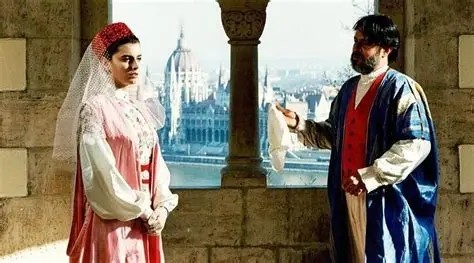
Photo: Pinterest
A legacy that must survive, even at the cost of life itself.
Throughout the journey, each character is compelled to confront personal histories, regrets, and unresolved longings. Narrative linearity dissolves into recollection and reverie. Geographic exile mirrors an inner displacement; Paris is no city of enlightenment, but a cold, indifferent space where Eastern sound hovers uneasily, suspended between recognition and oblivion.
At the emotional core of the film lies a restrained yet devastating love story. Taher, the group’s singer (played by Amin Tarokh), falls in love with a blind Ottoman princess (Leila Hatami). This relationship functions less as romance than as allegory: blindness and voice, seeing and hearing, East and West. Taher’s death in exile seals the film’s central paradox, a voice preserved for eternity, while its body disappears.
Music is not an accompaniment in Delshodegan; it is architecture. Composed by Hossein Alizadeh and sung by Mohammad Reza Shajarian, the score carries the emotional gravity of the film. Notably, Shajarian’s voice replaces that of the on-screen singer, yet Hatami deliberately avoids lip-synced close-ups. The disjunction between voice and body reinforces the film’s metaphysical tension: sound outliving flesh, memory severed from presence.
All lyrics in the film were written by Hatami himself, steeped in Qajar-era diction, ornate, melancholic, and deliberately archaic. This language is not nostalgic decoration; it is resistance. A refusal to surrender poetic complexity to modern simplification.
Visually, Delshodegan continues Hatami’s signature theatrical realism. Paris is recreated in Budapest, not to deceive, but to preserve a sense of stylization. Sets are knowingly artificial, compositions carefully staged. Hatami distrusts historical realism; he remains faithful instead to emotional truth.
Ultimately, Delshodegan is not a film about recording music, it is a film about recording time. About what remains when worlds shift and voices fade. Hatami’s answer is unwavering:
Sound.
If it is preserved.
If someone is willing to die for it.
Delshodegan endures as one of the most profound cinematic meditations on music, exile, and artistic responsibility in Iranian cinema, a film that continues to be heard, even when unseen.
This article is an original editorial analysis produced by [DIBA magazine].
Research and references are used for contextual accuracy.