
|
EN
Subscribe to our Newsletter
Mother Mary positions itself not as a narrative-driven film, but as a cultural examination of image-making in contemporary pop culture. Through the convergence of cinema, fashion, and sound, the film explores how bodies become personas, garments become structures of power, and visibility itself turns into a controlled performance. Rather than offering resolution, it constructs a space of observation, where image is not consumed, but negotiated.
By the Editorial Staff
January 16, 2026
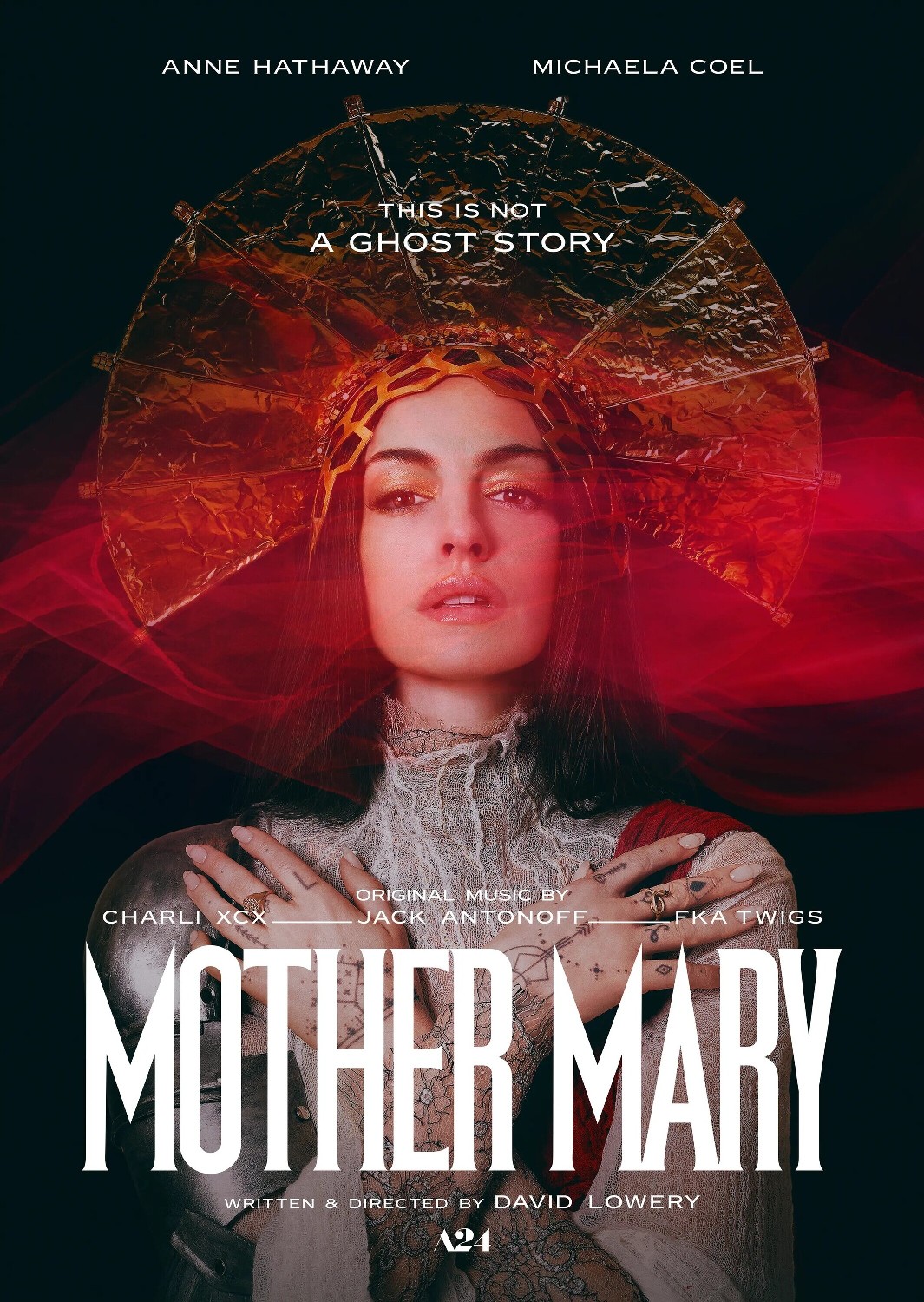
Mother Mary, 2026
Poster: A24
A Prelude to Image, Persona, and Pop Mythology
Before Mother Mary can be approached as a film, it must be understood as a cultural condition. This is not a project organized around linear narrative progression, character development, or plot resolution. Instead, it is structured as a study in image production, body regulation, and the mythology of contemporary pop visibility. Everything surrounding the film, its casting, its studio, its timing, signals an interest not in telling a story, but in dissecting a figure.
Mother Mary positions itself less as cinema and more as a diagnostic apparatus: an examination of how public identity is constructed, stabilized, disrupted, and consumed within an oversaturated visual economy. In this sense, the film belongs to a lineage of works that function as cultural mirrors rather than narrative vessels, films that observe systems rather than dramatize events.
A24 and the Cinema of Cultural Analysis
The role of A24 as production studio is not incidental. Over the past decade, A24 has established itself as a curator of films that exist in the liminal space between cinema, contemporary art, fashion imagery, and performance practice. Its projects often resist narrative closure, privileged atmosphere, embodiment, and conceptual coherence over traditional storytelling.
In films such as Under the Skin, The Bling Ring, The Lighthouse, and The Idol (despite its polarizing reception), A24 has repeatedly explored themes of visibility, control, desire, and mediated identity. Mother Mary appears to extend this trajectory, suggesting a film less concerned with “what happens” than with how cultural meaning is staged, framed, and circulated.
Here, cinema becomes an analytical surface. The screen does not absorb reality; it reflects the mechanisms through which reality is aestheticized.
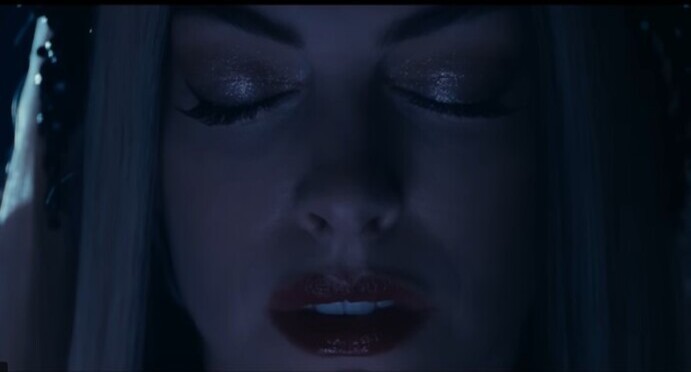
Mother Mary, 2026
Photo: You tube
Anne Hathaway: From Classical Presence to Managed Iconography
The casting of Anne Hathaway is one of the film’s most conceptually loaded decisions. Hathaway occupies a rare position within contemporary cinema: she is both a classically trained performer and a fully assimilated figure of mass visibility. Her body of work has consistently navigated systems of discipline—professional, emotional, and aesthetic.
Early roles framed her as a subject in formation, often positioned within institutional structures (The Devil Wears Prada, The Princess Diaries). Later performances emphasized interiority and vulnerability (Rachel Getting Married, Carol), situating her within emotionally exposed spaces. Mother Mary, however, appears to present Hathaway as a figure beyond formation: a woman who has already internalized the logic of visibility and now actively manages her own image.
Her expected performance mode here is not expressive but calibrated. Not emotional release, but emotional containment. Hathaway’s presence suggests a body that understands the camera, anticipates judgment, and performs restraint as a form of power. Gesture, posture, and stillness become communicative tools. Clothing, silence, and framing carry narrative weight equal to, if not greater than, dialogue.
In this configuration, Hathaway is not a character in crisis; she is a surface under control.
FKA twigs: Corporeality as Disruption
Where Hathaway embodies stabilization, FKA twigs introduces instability. Twigs’ artistic practice has consistently positioned the body as a primary language system, one that resists translation into conventional narrative or symbolic frameworks. Across her work, movement is meaning; breath is syntax; physical exertion is emotional grammar.
In Mother Mary, twigs are likely to function not as a character in the traditional sense, but as a force. A corporeal presence that disrupts the film’s visual economy. If Hathaway represents the managed image, the figure that survives by containment, twigs represents the body that cannot be fully disciplined.
Her presence introduces volatility:
fluidity against rigidity
improvisation against choreography
sensation against control
This is not merely a character opposition, but a formal one. The film’s visual logic is likely to oscillate between these two modes: the composed, frontal image versus the unstable, kinetic body. Twigs’ body does not obey framing, it challenges it.
Charli XCX: Pop Culture as Reflexive System
The inclusion of Charli XCX adds a third axis to the film’s conceptual framework. Charli’s cultural significance lies not in pop stardom alone, but in her meta-awareness of pop as a system. Her work consistently acknowledges the mechanics of fame, digital performance, and audience consumption, often incorporating irony, distance, and self-referentiality.
Within Mother Mary, Charli XCX likely occupies a liminal position:
neither resisting pop nor surrendering to it entirely.
She represents pop culture’s internal consciousness, its ability to observe itself while continuing to function. Her presence suggests a figure who understands the rules of the system and exploits them, without claiming full autonomy from them. She is not an innocent subject of image, nor a sovereign controller of it.
This positioning introduces a critical tension: pop as both trap and tool.
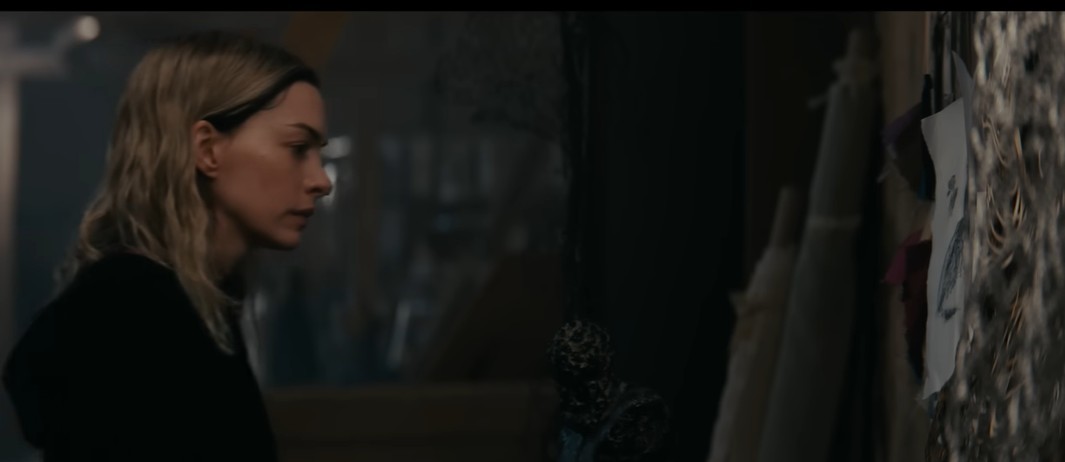
Mother Mary, 2026
Photo: You tube
Fashion as Narrative Infrastructure
In Mother Mary, fashion is not aesthetic garnish, it is narrative infrastructure. Clothing operates as architecture: structuring bodies, dictating movement, and producing meaning through restriction rather than embellishment.
Garments are expected to function as:
mechanisms of distance
tools of control
surfaces of projection
Rather than reflecting personal taste or emotional states, clothing defines the terms of visibility. It becomes a language of authority, hierarchy, and self-surveillance. The dressed body is not expressive, it is legible.
Given A24’s visual discipline, the film’s aesthetic language is likely to emphasize:
controlled palettes
deliberate silhouettes
minimal but charged movement
Emotion is suspended, not released. The image holds tension rather than resolving it.
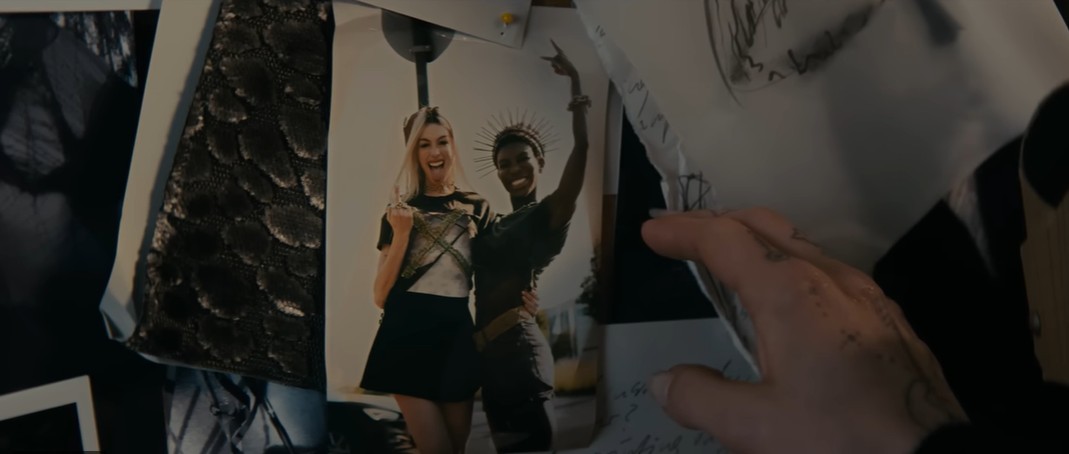
Mother Mary, 2026
Photo: You tube
Image, Persona, and Contemporary Myth
Ultimately, Mother Mary appears poised to operate as a mythological study of contemporary persona. Not myth in the classical sense, but myth as repetition, image reproduced until it becomes belief.
The film interrogates how figures are sanctified, consumed, and stabilized within pop culture. The title itself suggests reverence, projection, and symbolic motherhood, a figure onto whom meaning is endlessly inscribed.
In this context, Mother Mary is not asking who this woman is.
It is asking how she is seen, and why that visibility must be maintained.
Conclusion: Cinema After Narrative
Mother Mary signals a form of cinema that has moved beyond narrative urgency. It belongs to a mode where film functions as a critical environment rather than a storytelling device. A space in which bodies, images, and systems are placed under pressure and allowed to reveal their internal logic.
This is cinema as cultural anatomy.
Cinema as surveillance.
Cinema as myth-production.
And in that sense, Mother Mary is less a film to be watched than a structure to be entered.
This article is an original editorial analysis produced by [DIBA magazine].
Research and references are used for contextual accuracy.